
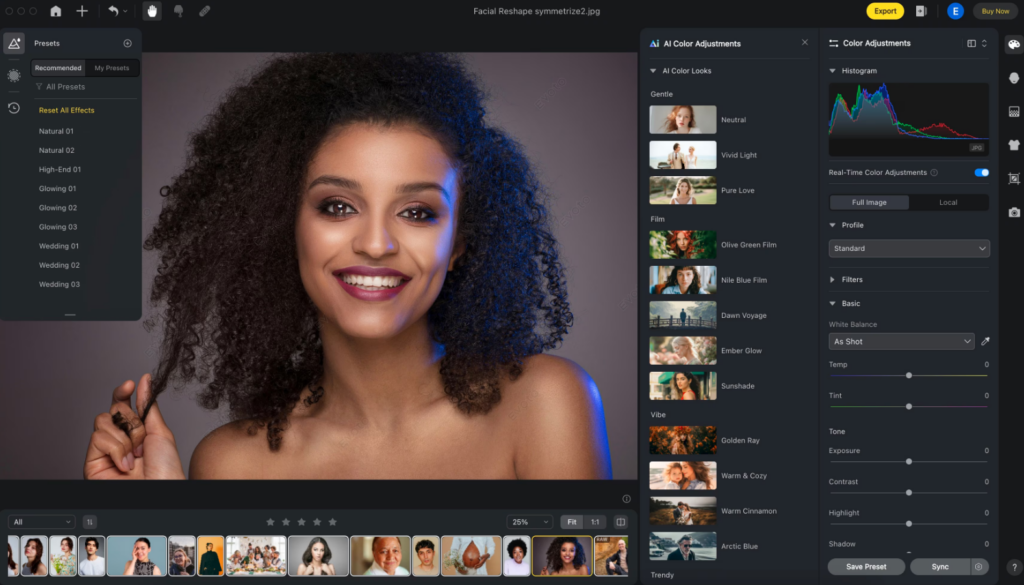
The limitation of traditional presets and even early AI filters was their one-size-fits-all nature. They applied a fixed, developer-defined look that often clashed with a photographer’s hard-earned style, requiring extensive manual tweaking that negated the time saved. Modern intelligent photo editing software is overcoming this by incorporating machine learning frameworks that can be trained on a user’s specific output. By analyzing a curated set of your “before and after” images, these systems deconstruct your editing decisions to build a mathematical model of your aesthetic, effectively creating a digital clone of your editing intuition.
This training process transforms a generic ai photo editor into your personal professional ai photo editor. The practical application is profound: after training, you can feed the software a completely new, unedited shoot, and it will apply adjustments that authentically mirror your style. This goes far beyond simple color matching; sophisticated systems can learn how you handle highlights and shadows in backlit scenes, how you sharpen portraits versus landscapes, and how you selectively saturate certain colors. For studios, this means the ability to train a single, unified “studio style” model, ensuring brand consistency across the work of multiple photographers and editors.
Implementing this technology requires an initial investment of time to curate a robust training set. The key is to select a diverse portfolio of your best-edited work that represents the full range of conditions you shoot in and the various subjects you photograph. The AI needs to see how you solve different problems to generalize your style effectively. This upfront effort, however, pays exponential dividends. Once trained, the model embedded in your smart photo editing software becomes a force multiplier, allowing you to batch-edit new work with a confidence that the foundational look will be unmistakably yours, requiring only fine-tuning rather than starting from scratch.
The evolution of this technology points toward a future where ai photo editing workflow is deeply collaborative. Imagine software that not only applies your style but also suggests alternative creative directions based on it, or that can differentiate between your “commercial clean” look and your “personal project moody” look based on project metadata. As these tools become more accessible within photo editing software for studios, they will fundamentally shift the editor’s role from executor to director and curator. The focus moves away from repetitive correction and toward creative choice and emotional storytelling.
This shift represents a fundamental change in the relationship between the photographer and their tools. The ai powered photo workflow of the future is less about issuing commands and more about engaging in a dialogue with an assistant that intimately understands your visual language. It promises a liberation from stylistic conformity, allowing photographers to automate their uniqueness rather than conform to a pre-set aesthetic. Embracing this technology means investing not just in a tool, but in a system that learns, grows, and evolves with you, solidifying your distinctive visual signature as the most valuable and scalable asset in your professional photo editing business.